
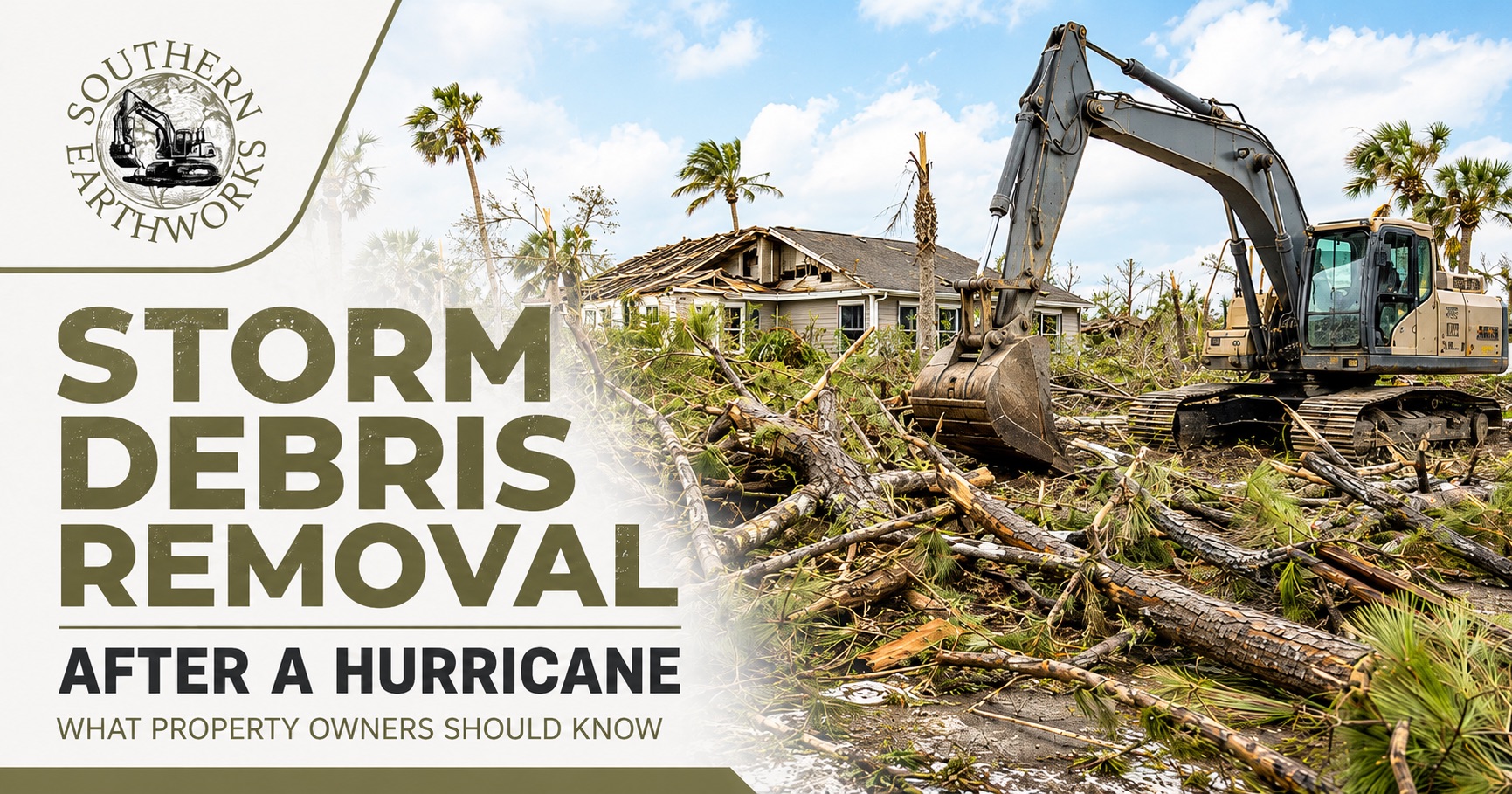
A hurricane can change a property in a matter of hours.
Strong winds can bring down trees and limbs, heavy rain can saturate the ground, and debris can block driveways, roads, access points, and areas around buildings. Once the storm passes, many homeowners and property managers are left looking at a property that needs to be made safe before normal life, repairs, or construction can move forward.
At Southern Earthworks, we provide professional storm cleanup and emergency debris removal for residential and commercial properties throughout Northeast Florida and Southeast Georgia. Our storm services include fallen tree clearance, uprooted stump removal, debris removal, clearing obstructions, structural cleanup, and post-hurricane site cleanup.
Safety Comes Before Cleanup
The first priority after a hurricane is not making the property look clean. It is making sure the property is safe enough to enter and evaluate.
Storm debris can hide hazards that are not immediately obvious. Fallen trees can remain under tension, broken limbs may still be hanging overhead, damaged structures can shift, and standing water may conceal unstable ground or other hazards.
If power lines are involved, keep your distance and contact the appropriate utility or emergency service. Do not attempt to move trees, branches, or other debris that may be touching electrical lines.
Large debris piles can also contain sharp metal, broken glass, damaged fencing, roofing materials, nails, and other construction debris. What appears to be a simple cleanup job can become dangerous very quickly without the right equipment and experience.
Our role at Southern Earthworks is to help clear storm damage safely and efficiently so property owners can regain access and move forward with repairs.
Fallen Trees and Limbs Can Block Critical Access
One of the most common problems after a hurricane is a tree or large limb blocking a driveway, road, gate, building entrance, or work area.
When access is blocked, cleanup can affect more than convenience. Contractors, utility crews, emergency vehicles, delivery trucks, and property owners may all need a clear route onto the site.
Southern Earthworks specifically handles fallen trees and limbs, driveway and structure obstructions, uprooted stumps, and storm debris. We use professional equipment to clear these areas and restore access as quickly as conditions allow.
This can be especially important for builders and commercial property owners who need crews back on site quickly after a storm.
Storm Debris Is More Than Just Tree Branches
Hurricane debris can include a wide range of materials.
A damaged property may have tree limbs, entire trees, roots, stumps, fencing, roofing, siding, outdoor furniture, building materials, soil, and other scattered debris.
Some storm cleanup situations also involve damaged structures or hardscapes that require heavier equipment and a more controlled cleanup process.
Southern Earthworks provides storm cleanup alongside site preparation, demolition, land clearing, excavation, and debris removal services, which allows us to handle properties where storm damage affects more than just landscaping.
The goal is to leave the site clean, accessible, and ready for the next step.
Uprooted Trees Can Leave Behind More Damage Than You Can See
When a large tree is uprooted, the visible trunk is only part of the problem.
The root ball can pull up large amounts of soil, damage nearby grading, create deep holes, disrupt drainage, and leave unstable ground behind. Removing the tree without addressing the disturbed area may leave the property difficult to use or unsafe for vehicles and equipment.
Because we also provide grading, excavation, soil stabilization, drainage solutions, and site leveling, we can evaluate what needs to happen after major debris is removed.
This is particularly useful when a storm-damaged property needs to be prepared for repairs, rebuilding, landscaping, or continued construction.
Heavy Rain Can Create Drainage Problems During Cleanup
Hurricanes often leave the soil saturated long after the wind has died down.
Water may collect in areas where trees were uprooted, where debris blocked an existing drainage route, or where erosion changed the grade of the property.
Moving heavy debris across wet ground also requires care. Poorly planned equipment access can create ruts, compaction, or additional damage.
At Southern Earthworks, our earthwork services include grading, slope correction, excavation, drainage solutions, and soil stabilization. That means if cleanup exposes a larger site issue, we have experience with the work that may be required to get the property stable and usable again.
Property Owners Are Responsible for Debris on Their Property
After a major storm, public agencies may establish debris collection procedures, staging areas, or temporary cleanup programs. However, private property owners should understand that debris located on private property is generally their responsibility.
The Florida Department of Environmental Protection states that private property owners are responsible for removing debris from their own property. The state also maintains guidance for hurricane-generated debris, approved debris management sites, and post-storm cleanup.
Property owners can review the official Florida Department of Environmental Protection hurricane debris cleanup information for current state guidance.
Local rules may also affect where debris should be placed, how different materials should be separated, and when public collection is available. After a major hurricane, check with your county or municipality for instructions before moving large amounts of debris to a roadside or public right-of-way.
Separate Hazardous Materials From Ordinary Storm Debris
Not everything damaged in a hurricane should be placed into the same debris pile.
Paint, fuel, chemicals, batteries, propane tanks, pesticides, oil, electronics, and other potentially hazardous materials may require different handling from vegetative debris or ordinary construction materials.
Florida DEP provides emergency response and hazardous-material guidance following hurricanes and other natural disasters.
If you are unsure whether a material is safe to move or dispose of with regular debris, contact the appropriate local or state agency before handling it.
A professional storm cleanup contractor can remove many of the large physical obstructions from a property, but hazardous materials may require specialized handling.
Take Photos Before Major Cleanup Begins
If the storm caused significant property damage, it can be helpful to document conditions before cleanup begins.
Photograph damaged trees, structures, roofs, fences, outbuildings, vehicles, debris locations, and blocked access areas from a safe distance.
Documentation may be helpful when speaking with an insurance company, property manager, contractor, or other party involved in repairs.
Do not put yourself in danger to take photos. If an area appears unstable or has electrical hazards, stay away from it.
Do Not Rush Into DIY Tree Removal
After a hurricane, fallen trees may look easier to cut apart than they actually are.
A tree that has fallen across another tree, structure, or fence may still be under significant tension. Cutting the wrong limb or trunk section can cause the tree to shift unexpectedly.
Partially uprooted trees can also move as saturated soil settles. Broken limbs may remain suspended overhead.
Professional crews have equipment designed to lift, move, cut, and remove large debris in a more controlled manner.
Southern Earthworks is fully licensed and insured, has Master Logger certification, access to arborist expertise, and experienced crews equipped for storm damage cleanup and land work.
Cleanup May Be the First Step Toward Rebuilding
For some properties, storm debris removal is only the beginning.
Once the fallen trees and damaged materials are removed, the site may still require grading, excavation, demolition, drainage repairs, foundation preparation, or additional clearing.
Our broader services allow us to help property owners transition from emergency cleanup into site preparation.
We provide earthwork and site prep, demolition, land clearing, grading, drainage solutions, tree and stump work, and debris removal for residential and commercial properties.
This can help simplify the recovery process when multiple types of work are needed on the same property.
Commercial Properties Have Different Cleanup Priorities
Storm damage can be especially disruptive for commercial sites, active construction projects, rental properties, developments, and managed communities.
A blocked entrance, damaged access road, fallen tree, or debris-covered work area can prevent employees, tenants, customers, subcontractors, or delivery vehicles from safely entering the property.
For these sites, the goal is often to restore safe access and create a clear path for the next crew as efficiently as possible.
Southern Earthworks works with homeowners, builders, businesses, developers, contractors, and property managers throughout Northeast Florida and Southeast Georgia.
Why Professional Storm Cleanup Matters
Storm cleanup often requires much more than loading branches into a trailer.
Large trees, stumps, damaged structures, heavy debris, unstable soil, and blocked access can require excavators, loaders, chainsaws, hauling equipment, and experienced operators.
The right crew should also understand how to work around remaining structures, landscaping, utilities, drainage areas, and other property features.
Southern Earthworks has completed more than 1,000 projects since 2021 and is fully licensed and insured. Our team provides emergency service and serves property owners throughout Northeast Florida and Southeast Georgia.
We focus on clearing properties safely, efficiently, and professionally so the site is ready for whatever comes next.
When Storms Strike, We Are Ready to Help
A hurricane can leave behind fallen trees, blocked driveways, damaged structures, uprooted stumps, and debris throughout a property.
You do not have to handle that cleanup alone.
At Southern Earthworks, we provide fast, professional storm debris removal, fallen tree clearance, structural cleanup, emergency site clearing, and property restoration for residential and commercial customers.
If you need storm debris removal in Florida, a reliable hurricane cleanup contractor, or professional emergency debris removal, contact our team as soon as it is safe to do so.
Call Southern Earthworks at 904-583-9908 or request a free estimate through our contact page.



Leave A Comment