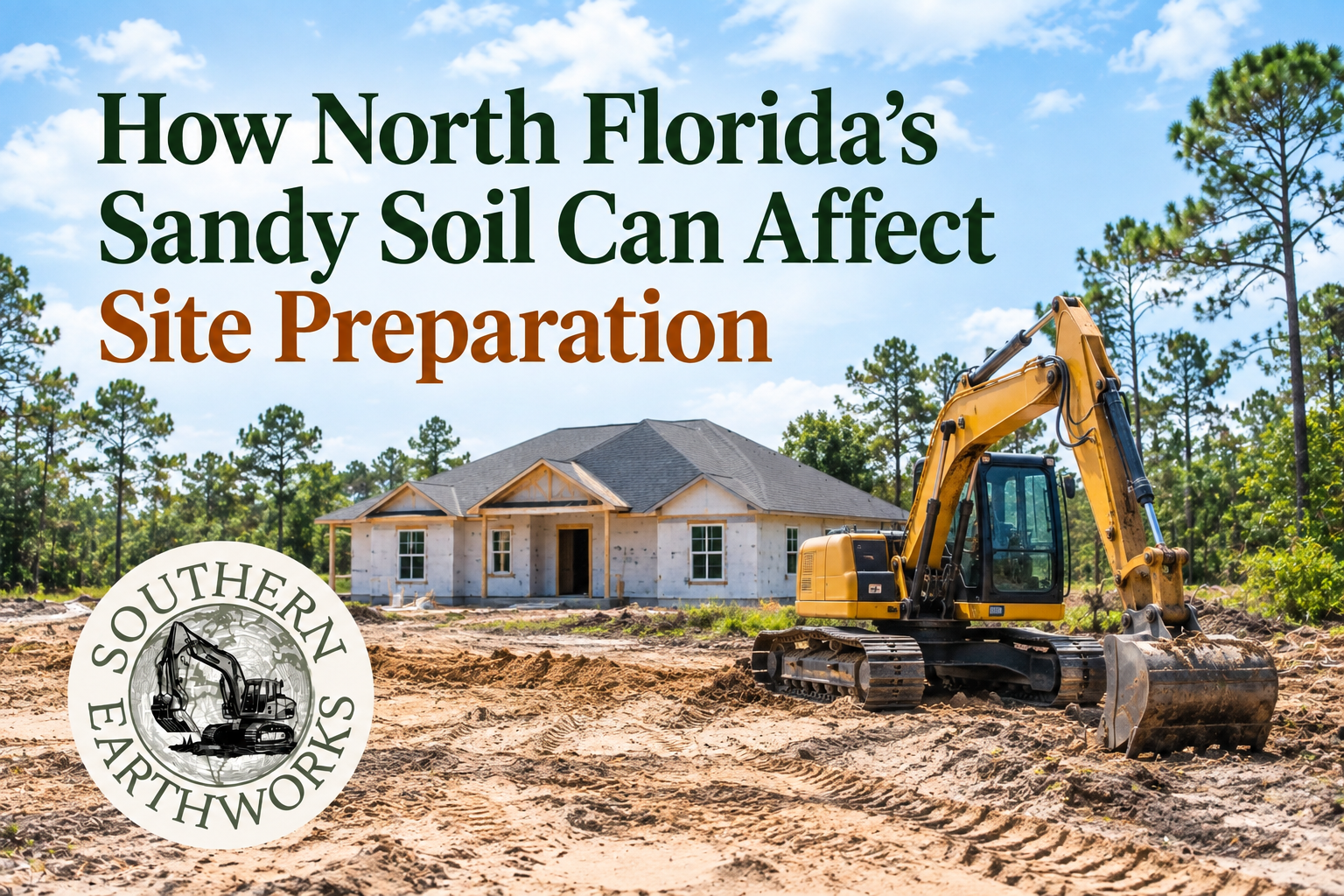
When you’re preparing land for new construction, a driveway, a commercial development, or another major project, it’s easy to focus on what’s happening above ground. Clearing trees, removing stumps, moving dirt, establishing grades, and getting the site ready for construction are all important steps.
But what’s happening underneath the surface matters just as much.
Here in North Florida, many properties have naturally sandy soils. Sandy soil can provide good natural drainage, but it can also create challenges during site preparation. Understanding the soil conditions on a property before work begins can help address drainage, erosion, compaction, grading, and other issues that can affect a project later.
At Southern Earthworks, we provide professional land clearing, earthwork, grading, excavation, drainage, soil stabilization, and site preparation throughout Northeast Florida. We understand that every property is different, and proper site preparation starts with understanding the land we’re working with.
Why North Florida Has So Much Sandy Soil
North Florida, Jacksonville, Amelia Island, Nassau County and more are known for its sandy soils, and that can have a major impact on how a property handles water and construction activity.
One advantage of sandy soil is that it generally allows water to move through the soil relatively quickly. That can be helpful when a property needs good natural drainage.
However, sandy soil doesn’t automatically mean every property will drain properly. Elevation changes, existing grading, compacted areas, fill material, and the property’s overall layout can all affect how water moves across the site.
According to the University of Florida IFAS guide to soil assessment in Florida, Florida surface soils commonly fall into sandy, loamy sand, or sandy loam categories. Sandy soils are often well-drained, but they can also have lower water-holding capacity.
For a construction or development project, understanding those characteristics before work begins can make a significant difference.
Sandy Soil Can Affect Grading and Drainage
Proper grading is one of the most important parts of site preparation.
When we prepare a property, we’re not simply trying to make the ground flat. The finished grade needs to work with the surrounding property and direct water where it needs to go.
On a sandy site, water may move through the soil quickly in some areas while surface water can still collect in other areas because of the property’s topography or changes made during construction.
Drainage problems can be caused by natural topography, grading during construction, or existing soil compaction. Low areas and locations where water remains after rainfall can be signs that a property needs additional evaluation or grading.
This is one reason site preparation should be approached as more than simply moving dirt from one location to another.
Construction Can Change the Soil
A property may have naturally sandy soil, but construction activities can significantly change the condition of that soil.
Heavy equipment, repeated traffic, excavation, imported fill, and grading can all disturb the existing soil profile.
Construction can also lead to compaction. Heavy equipment and repeated site traffic can change the physical characteristics of soil and reduce the spaces through which water and air move. UF/IFAS notes that construction and equipment traffic can compact even sandy soils.
That’s important because the soil you’re working with after clearing and construction may not behave exactly like the soil that was there before the project started.
For example, a site may have areas where equipment has repeatedly traveled, creating compaction. Other areas may contain imported fill or material that has been moved around during previous work.
Understanding those differences helps us determine how the property should be prepared for the next stage of construction.
Soil Compaction Can Still Be a Problem in Sandy Areas
It’s easy to assume that sandy soil cannot become compacted because it feels loose and moves easily.
That’s not the case.
Heavy equipment and repeated traffic can compact soil, including sandy soils. Compaction changes the pore space within the soil and can affect water infiltration and other soil characteristics.
For a construction project, some compaction may be intentional when preparing areas that need to support structures or other engineered loads. The important thing is understanding where compaction is needed and where it could create problems.
Compaction in other areas can affect drainage, landscaping, and the performance of the finished site.
During site preparation, identifying areas that have been heavily disturbed or compacted can help determine whether additional grading, excavation, soil work, or stabilization may be appropriate before construction continues.
Fill Dirt and Imported Material Matter
Another factor we consider during site preparation is whether additional material has been brought onto the property.
Fill material may be used to raise elevations, establish grades, prepare areas for foundations, or create other necessary site conditions. However, different materials can behave differently when water moves through them or when they are placed and compacted.
Construction activities can also alter the original soil profile, making it difficult to know exactly what natural soil conditions existed before the work began. UF/IFAS recommends evaluating soil conditions and understanding how disturbed or compacted a site has become.
This is why understanding the existing site conditions is important before simply adding more material.
The goal isn’t just to move dirt. The goal is to create a site that is properly prepared for what comes next.
Sandy Soil and Erosion
Water movement is another consideration on sandy properties.
When rainfall moves across exposed soil, it can carry loose material with it. This can become especially noticeable after land clearing when vegetation that previously helped hold the soil in place has been removed.
Proper grading and thoughtful site preparation can help control how water moves across the property and reduce unnecessary erosion.
This becomes particularly important during Northeast Florida’s periods of heavy rainfall and tropical weather. A site that appears stable during dry conditions can behave very differently after a significant rain event.
Why Site Preparation Should Happen Before Construction Begins
One of the biggest mistakes property owners and developers can make is treating site preparation as an afterthought.
Clearing a property is only one part of getting land ready for construction.
Depending on the project, the site may also need grading, excavation, drainage improvements, soil stabilization, foundation preparation, or pad construction.
At Southern Earthworks, we provide these types of earthwork and site preparation services for residential and commercial projects throughout Northeast Florida. Our services include land clearing, debris removal, grading and leveling, excavation, foundation preparation, drainage solutions, pad construction, and soil stabilization.
Taking the time to properly prepare the property can help create a better starting point for the construction that follows.
Every Property Has Different Soil Conditions
Even two properties located relatively close to each other can have different site conditions.
One property may have relatively straightforward sandy soil and good natural drainage. Another may have low areas, compacted sections, existing fill, drainage concerns, or other conditions that require a different approach.
That’s why we don’t believe in taking a one-size-fits-all approach to site preparation.
We look at the property, the project requirements, the existing terrain, and what needs to happen next. From there, we can determine what type of earthwork is needed to move the project forward.
If you’re developing property in Yulee, Fernandina Beach, Amelia Island, Jacksonville, Nassau County, or elsewhere in Northeast Florida, the soil underneath your property is an important part of the project.
North Florida’s sandy soil can provide good natural drainage, but it can also present challenges when the land is cleared, graded, excavated, or developed. Understanding soil conditions, managing water movement, addressing compaction, and establishing proper grades can all play an important role in preparing a property for construction.
At Southern Earthworks, we help homeowners, builders, contractors, and developers prepare properties for what’s next. From land clearing and excavation to grading, drainage, soil stabilization, and foundation preparation, our goal is to provide the earthwork needed to create a properly prepared site.
If you’re planning a construction or development project and need to prepare the property, request a free estimate from Southern Earthworks or call 904-583-9908.




Leave A Comment